
News

News

The State of the Social Care Sector: How did social enterprises respond to Covid-19?

Over the last decade the social care sector in England has seen unprecedented demand coupled with funding cuts and workforce recruitment and retention challenges. The Covid-19 pandemic added more pressure to already stretched social care systems. Recent research at the University of Birmingham has been exploring the contribution of social enterprises to the adult social care sector. As part of this research, we analysed data from the 2019 and 2021 ‘State of Social Enterprise’ survey focusing only on social enterprises delivering social care services (‘care social enterprises’). We looked at any changes in the sector immediately before and after the pandemic. Overall, the survey suggests that the care social enterprise sector responded positively to the challenges of Covid-19. Between 2019 and 2021, most care social enterprises not only survived, but we found generally positive indications of growth and reports of diversification and innovation. Whilst the pandemic created challenges for the sector, including financial difficulties – with 32% of care social enterprises reporting that they drew on their financial reserves and 20% having increased borrowing in response to the pandemic - most (68%) did not pass any financial burden on to their service users. Many care social enterprises surveyed reported that their annual income had increased; with almost twice as many organisations reporting an annual income exceeding £1m in 2021 than had done in 2019, although the actual proportion reporting income exceeding £1m was relatively small (just under 20% in 2019), with medium income of £100,000. More care social enterprises also reported making a profit in 2021 (56%) compared to 2019 (44%). An overwhelming 81% of care social enterprises surveyed reported that they changed their processes and/or ways of thinking in response to the pandemic. As well as adapting in response to Covid-19, care social enterprises were found generally to be dynamic; in 2021, 48% reported that they had expanded into new markets and 62% had developed new products. Many also reported that they had expanded the reach of their services, with over three quarters (78%) operating across more than one local authority area in 2021 (compared with 59% in 2019). Similarly, the number of employees in care social enterprises increased between 2019 and 2021 from a median of five to twelve employees, and more than two-thirds (68%) expected their staff number to growth further. Whilst the number of staff grew, staffing was affected by the pandemic with 42% of care social enterprises reporting furloughing staff, 44% asked staff to take on additional roles, and over half provided or switched to remote working.  The most common objective of care social enterprises was reported as ‘supporting vulnerable people’ and one notable trend over the last two years has been the prioritisation of adult mental health and wellbeing. Whilst this is reflected in the entire social enterprise sector [1], with nearly a third of the sector prioritising adult mental health and wellbeing as a main objective, a more dramatic shift is visible in care social enterprises with adult mental health listed as a priority objective by 27% in 2019, and more than doubling to 59% in 2021.  This is congruent with increasing demand on NHS mental health services post COVID19 [2] and supports the notion of adaptability and resilience in recent years in the care social enterprise sector. Care social enterprises therefore appear to have responded well to the COVID-19 pandemic. They are widely recognised as driving innovation and as having real expertise around their communities. These qualities may make them well placed to fill some of the gaps in statutory care and support, and in turn gain recognition as integral stakeholders in health and care systems [3]. In recent years care social enterprises have therefore proven their ability to adapt and innovate in response to changing demands and challenges.  Furthermore, they have continued to grow and remain profitable in the face of crisis. By Kelly Hall, Kelly Hayward and Phil Kinghorn, University of Birmingham  [1] SEUK (2021) No going back- state of social enterprise survey 2021, https://www.socialenterprise.org.uk/seuk-report/no-going-back-state-of-social-enterprise-survey-2021/ [2] NHS Confederation (2021) Increase in demand for mental health support is being felt across the system, 25 October 2021, https://www.nhsconfed.org/articles/increase-demand-mental-health-support-being-felt-across-system [3] ADASS (2020) The voluntary and community sector in a world shaped by Covid https://www.adass.org.uk/next-steps-for-the-vcs-the-voluntary-and-community-sector-in-a-world-shaped-by-covid

16 Dec

by Kelly Hall, Kelly Hayward and Phil Kinghorn, University of Birmingham

Continue reading

3 min

News

Winners of UK Social Enterprise Awards announced at the Camden Roundhouse

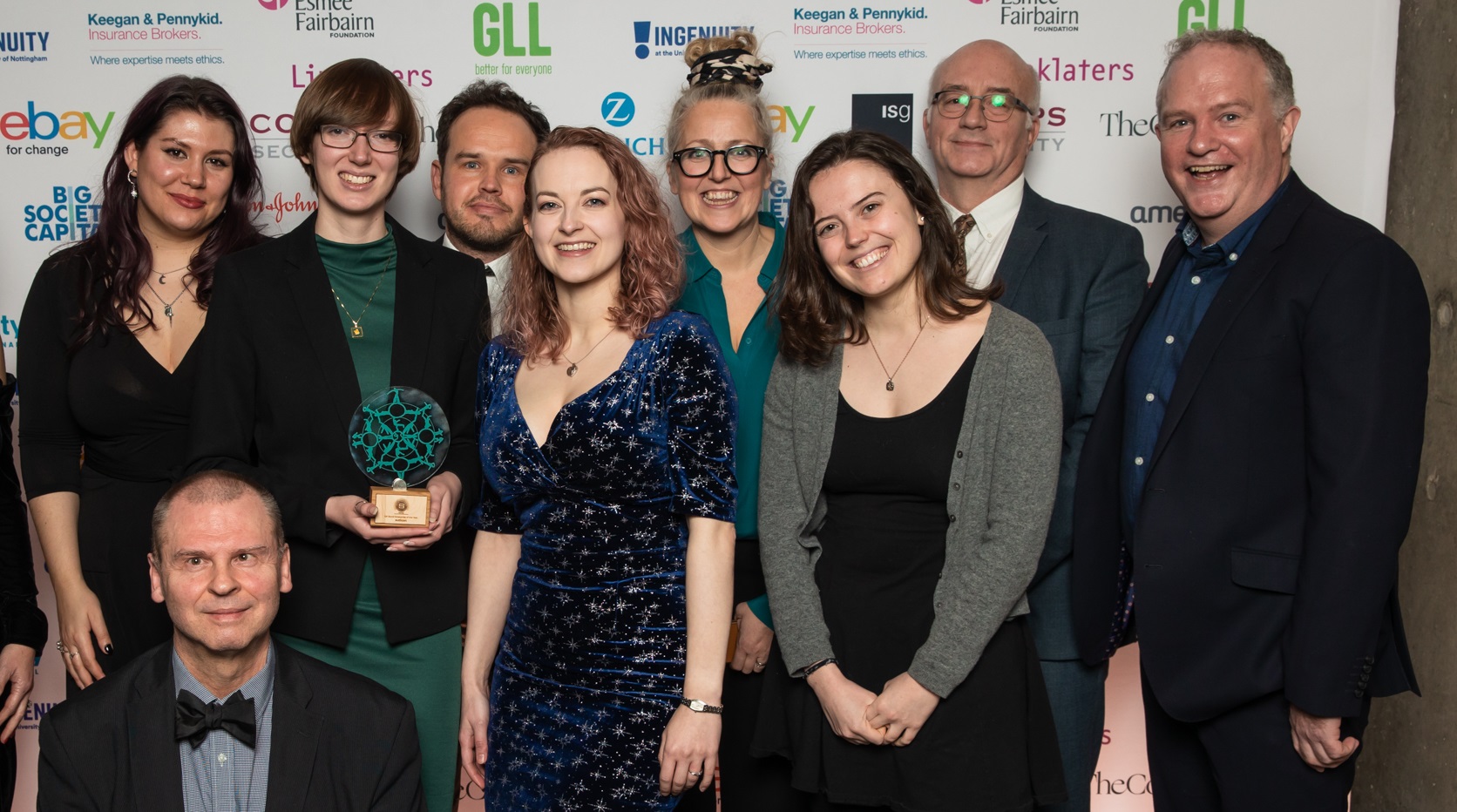
The winners of the UK Social Enterprise Awards 2022 were announced last night at a gala reception at the iconic Roundhouse in Camden, London. The Awards were a celebration of the impact of the UK’s social enterprise community and brought together leading social enterprises with supporters of the sector – from corporates to social investors. It was a real showcase of why social enterprise represents business at its best and, across fifteen categories, highlighted the diversity and strength of the sector. The winner of the overall Social Enterprise of the Year Award was auticon, the pioneering international tech consultancy that exclusively employs professional consultants on the autism spectrum. View the full list of winners here Guests enjoyed entertainment from Alex Horne and his band The Horne Section as well as from award-winning comedian Shazia Mirza and performers from social enterprise, Black Sheep Collective. Commenting on the Awards, Peter Holbrook, Chief Executive of Social Enterprise UK said: “The last year has been a difficult one for businesses across the UK, and it has been no different for social enterprises. The Awards were a real evening of hope and inspiration and brought home the sheer ingenuity, adaptability and determination of the social enterprise community, which has continued to deliver for the people and communities they work with and support. “The winners include businesses which are breaking down barriers for groups marginalised in the workforce, organisations at the heart of local economies, and those finding innovative ways to tackle the climate crisis. The ever-growing movement of social enterprise truly represents business at its best.” As well as celebrating the successes of the social enterprise movement the Awards used a social enterprise supply chain. Trophies were made by Designs in Mind – a social enterprise working with adults living with mental health challenges and catering was provided by The Clink, a business working in prisons. Social enterprise also provided the photography, table gifts, awards brochure and water. SEUK worked with social enterprise event management company, Fuse Events, to run the event. The Awards were delivered in partnership with Cwmpas, Social Enterprise Northern Ireland and Social Enterprise Scotland.

09 Dec

Continue reading

2 min

News

The Social Value Podcast

29 November 2022 Social Enterprise UK has launched a new podcast exploring the ways in which social value can be used to help businesses, the public sector and Government to develop a fairer, greener society.   Social value is a way of maximising the positive social, economic and environmental impact of organisations. The Social Value Act, introduced in 2012, made it obligatory for public bodies to consider how the services they commission and procure might improve the economic, social and environmental well-being of the areas they operate in. The aim of the Social Value Podcast is to help leaders in the public and private sector, to understand how using a “social value” approach will enable better decisions. The podcast is a part of the Social Value 2032 programme, a partnership between Social Enterprise UK, Jacobs, PwC, Shaw Trust, Siemens and Suez Recycling and Recovery UK. The programme aims to extend the use of social value across the public and private sectors and highlight how procurement can drive improvement and greater sustainability in businesses and markets in the UK, transform public services and accelerate the drive to Net Zero. On the first episode of The Social Value Podcast, Michelle Levi, Social Impact Lead for Europe at Jacobs, discusses the importance of building an organisational culture that supports and champions social value. You can listen to The Social Value Podcast at https://www.socialenterprise.org.uk/socialvaluepodcast/ Episodes are also available on Spotify and Apple Podcasts. Find out more about Social Value 2032 here.

29 Nov

Continue reading

1 min

News

Introducing the Social Enterprise Knowledge Centre

Social Enterprise UK has today launched the Social Enterprise Knowledge Centre – which aims to be a world-class source of evidence and insights on social enterprise. For more than a decade, our data and evidence has been the foundation of much of the research on social enterprise in the UK. Information collected by us on social enterprise activity drives understanding, awareness and progress. It informs public policy, from the creation of Better Society Capital (formerly Big Society Capital) and Access – The Foundation for Social Investment, to the Social Value Act and the development of public service mutuals, as well as the recent Adebowale Commission on Social Investment. The new Knowledge Centre brings together evidence compiled by us with wider sources of data, to make the UK’s most comprehensive source of information about social enterprise. It houses qualitative and quantitative information and will produce evidence for a range of audiences exploring key thematic areas of interest for social enterprises and their support ecosystem. Working in partnership with social investors, foundations, government, support organisations, academia and social enterprises, the Knowledge Centre will produce a wide range of reports and insight to promote understanding and inform positive change. Click here to visit the knowledge centre The Knowledge Centre is the home of our State of Social Enterprise Reports – our flagship piece of research looking in depth at the UK social enterprise community. Published every two years the report highlights key trends in the social enterprise sector. It also houses our quarterly Barometer reports which give a snapshot of social enterprise performance as well as how specific economic and political developments are affecting social enterprises. The Social Enterprise Knowledge Centre is supported by Access – The Foundation for Social Investment. Social Investment Business and Better Society Capital.

09 Nov

Continue reading

2 min

1 2 3 4 5 6 9 4 of 9