News and views
Social enterprises stand up for social value

Survey respondents give strong backing for government supply chain diversity and reserving contracts below £1m for VCSEs and SMEs. Social enterprises also think the new definition of social value is too narrow.
When we first published our response to the government’s social value changes in August, we received a lot of feedback on social media, particularly on a post by our CEO Peter Holbrook. It was clear that members and stakeholders felt very strongly about this, and, as the national voice for social enterprise, we needed to represent those views to government.
To clarify those views, we launched a survey. Open for a week, the survey had 95 responses; 66% of respondents told us they were social enterprises, 16% identified as charity or VCSE, 4% were cooperatives, and 14% of responses were from other kinds of organisations.
More than two thirds of respondents bid for public sector contracts (70%), with a majority bidding for contracts under £1m (55%). The social value weighting for contracts for £5m or more doubled to 20% recently, but just 9% of respondents bid for these.
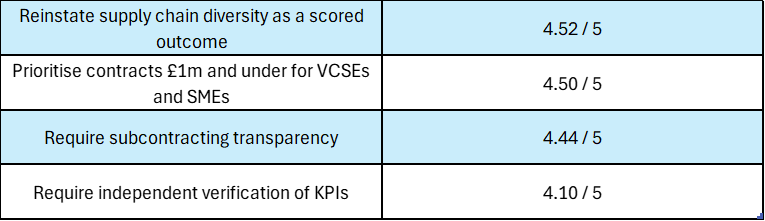
The most common responses to the social value changes we initially received resulted in four main asks. We included these in the survey to ensure our stakeholders thought we’d got it right. They were:
- Reinstating supply chain diversity (listed in PPN002), as many social enterprises benefit from being subcontracted by suppliers winning larger contracts.
- Subcontracting transparency.
- Independent KPI verification, so that promises made on social value creation were kept. “Suppliers should not win contracts on promises nobody checks,” wrote survey respondent Heidi Fisher of Make An Impact CIC,.
- £1m contracts or less offered to VCSEs and SMEs first. This was also reflected in feedback we got from the survey. DHU Healthcare, which provides a range of NHS services in the Midlands, wrote “Organisations such as Community Interest Companies are established to create community benefits and reinvest surpluses for social purpose. Procurement should provide a proportionate way to recognise the underlying business model and the social value it generates, alongside measurable contract-specific commitments.”
The four asks got strong support in the survey. We asked respondents to rate them from 1-5, with 1 being not important and 5 being essential. The average scores are listed below:
New social value definition too narrow
The survey also surfaced an additional recommendation for government. Whilst recognising that job opportunities and skills creation were important (and indeed, plenty of social enterprises are set up specifically to offer this), the new definition of social value was too narrow for our respondents. Several noted that it did not align with the Public Services (Social Value) Act, which requires commissioners to offer contracts producing economic, social and environmental benefits to communities.
Mastercall Healthcare, which provides NHS services in the Northwest of England, articulated this very simply: “Social value should be defined broadly enough to recognise the full contribution organisations make to the communities they serve. In health and social care this should include reducing health inequalities, improving population health and wellbeing, environmental sustainability, community engagement and co-design, local reinvestment and support for vulnerable or underserved communities. Local communities should also have a meaningful role in defining what social value and local benefit mean to them.”
When we asked respondents if social value should be defined more broadly than jobs and skills, 73% said yes.
What happens next?
We’ll be delivering your recommendations to the government, along with a letter to the Cabinet Office, which has been signed by social enterprises that paticipated in the survey.