
News and views
Defending defence? Can social enterprises engage meaningfully with defence-driven growth plans?

Social Enterprise UK’s Director of Research and Policy, Emily Darko reflects on a trip to Plymouth, a Social Enterprise City, where she took part in a panel discussion on how and if social enterprises can play a part in the city’s plans for defence-driven growth.
The Ministry of Defence is investing £4.4 billion over 10 years to upgrade Plymouth’s naval base, a transformative sum for a city where defence comprises 14% of the economy. The city is also set to gain a share of £250 million announced in the Defence Industry Strategy. The investment promises jobs, skills development, housing, regeneration, and broader social value.
In theory, this defence-driven growth will create jobs, skills, and growth – and will contribute to regeneration, housing, skills development, transport infrastructure and wider social value. But in a world where violent conflicts claim an increasing number of lives, should the social enterprise movement be contributing to socially impactful defence solutions? Can it? A coop making socially impactful bombs – made from repurposed materials, embedded with flower seeds to rewild land they fall on? Probably not. But when government announces long-term, multi-billion pound defence investment, social enterprise must have a role to play to ensure the investment is spent as impactfully as possible.
On Social Enterprise Day, I joined stakeholders in Plymouth to address this question. In a global context where people are increasingly likely to die as a result of violent conflicts, it makes sense to question investment which includes actors active in production of weapons. Personal and professional stances may vary. There is a spectrum of potential: ignore – avoid/boycott – engage – influence – change. For those who opt to actively participate, what to do? The collective experience of social enterprises offers answers.
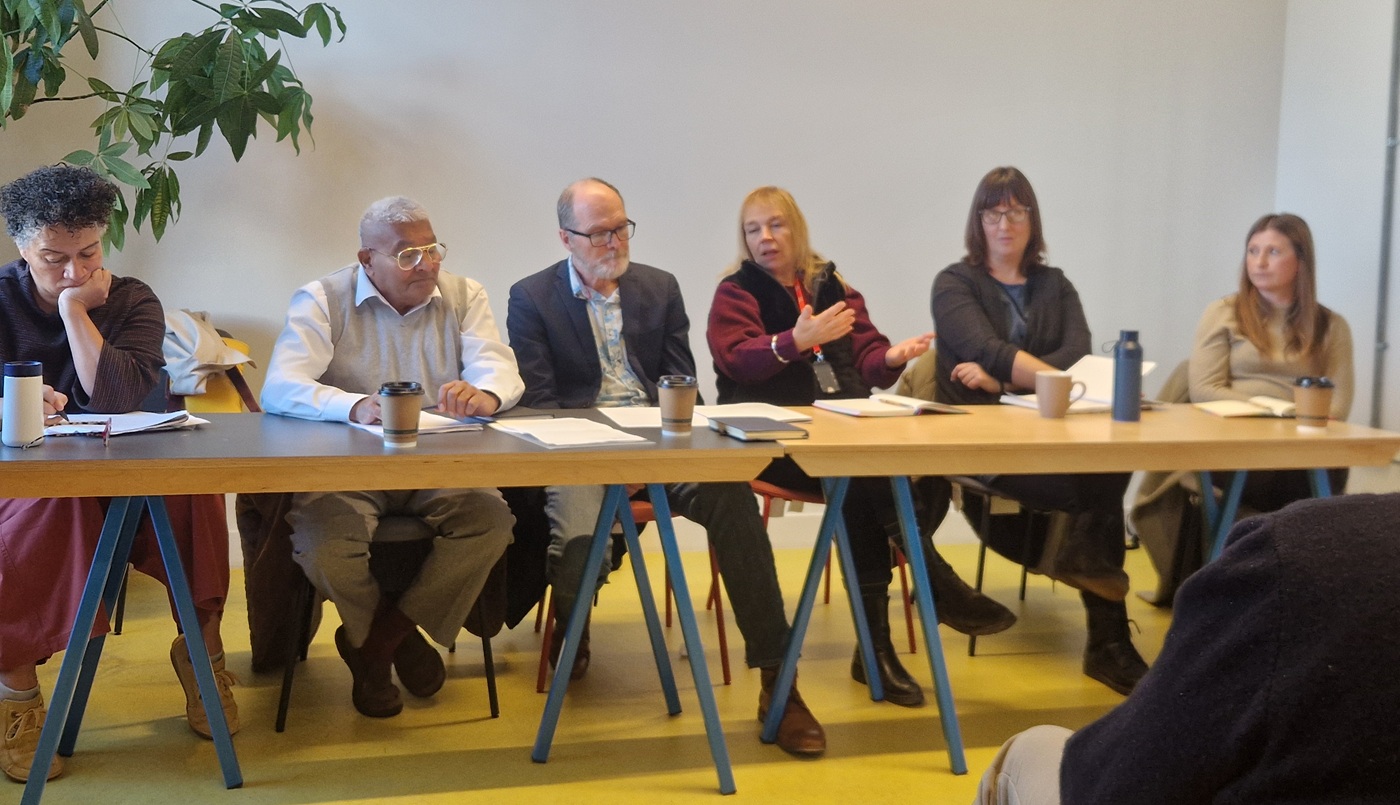
Emily Darko (second from right) with fellow panalists – Gareth Hart, Director, PSEN; Pat Patel, CEO, Tamar View Community Complex; Hannah Harris, CEO, Plymouth Culture; Esther White, Manager, Plymouth Quakers; and Lindsey Hall, CEO, Real Ideas
Making Engagement Count
For those who choose to participate, good intentions aren’t enough. History shows that promised social benefits often become secondary to primary objectives unless mandated and monitored.
Collaboration, co-creation, partnership and fostering mutual respect are core components of progressive commissioning and procurement. Big business, government, civil society, social enterprises speaking different languages and bringing different value. Pulling this all together isn’t easy – but is powerful. And when done well, worth the bother.
Most businesses, like government, and indeed most humans, are driven by fundamental pressures – understanding and using these to shape change is key. Big business will, broadly, comply with legal and regulatory requirements, react to competitor behaviour and market conditions, and respond to pressure from consumers and stakeholders, particularly where it influences one of the other conditions – or of course financial performance.
This is why policy matters. Promises of jobs, skills development, housing, and regeneration risk being secondary to delivering primary goals of upgrading the naval fleet unless they are a mandated requirement, and providers held to account on delivery – not upfront plans.
So what does meaningful engagement look like in practice?
Early and sustained dialogue: Team Plymouth’s plans for pre-delivery engagement on regeneration and skills development provide a foundation. Local infrastructure organisations like Plymouth Social Enterprise Network can translate deep community expertise to government and business stakeholders, building partnerships that demonstrate the value social enterprises deliver. Dialogue with substance, hearts and minds won through evidence of the solutions social enterprises provide, derisking use of those solutions through partnerships.
Addressing process and regulatory barriers: Standardised measurement tools can exclude impactful actors. Procurement processes that favour economies of scale don’t necessarily deliver impacts of scale. Complex requirements, slow payments, and perverse incentives risk sidelining better providers. These structural issues need tackling at both local and national levels.
Strengthening regulation: This means pushing for regulatory support – nationally, through strengthening Social Value and Procurement legislation, in line with proposals raised earlier this year through the Procurement Act consultation. And locally, through Plymouth’s social enterprise strategy and economic growth plan.
Ongoing monitoring: As investment flows, maintaining constructive dialogue matters. Plymouth has seen both successful regeneration and entrenched deprivation. Social enterprises understand the barriers and complexity of solutions and these insights can and should inform delivery throughout the decade ahead.
A Vision for 2035
In 2035, Plymouth could be a city with an upgraded naval base alongside a thriving economy, with most of the £4.4 billion invested locally. Skilled locals with transferable skills employed across engineering, marine conservation, manufacturing, and construction. Sustainably-built affordable housing that is changing health outcomes for communities facing intergenerational poverty. A strengthened cultural sector and creative industries contributing to the ‘Ocean City’ identity. Local SMEs and social enterprises embedded throughout supply chains, providing community services that outlast the construction phase.
This vision is achievable but only with intentional design, accountability, and sustained engagement from diverse stakeholders.
Does achieving this offset concerns about engaging with companies exporting arms to conflict zones? This doesn’t need to be binary. It is possible to engage with the practicalities of potentially positive investment, and still maintain that a world without violent conflict and without greedy profit maximisation is the ultimate goal.
Plymouth has a deep heritage as a defence city. It is also a thriving Social Enterprise City. And that gives us reason for hope.