News and views
Communities want to own the spaces that matter to them. What’s standing in the way?
At an APPG evidence session in Bristol, social enterprises, funders and investors said new rights for communities to buy local assets will mean little without patient money, practical support and a fairer deal on rates.
“Community right to buy is pretty much useless without a community ownership fund.” That was the verdict of Kathryn Chiswell Jones, CEO of Artspace Lifespace, at the latest evidence session of the Social, Cooperative and Community Economy All-Party Parliamentary Group, held at Watershed in Bristol on Friday 20 November.
Chaired by Patrick Hurley MP, the session explored how communities can gain greater ownership, control and stewardship of the buildings, land and spaces that matter to them – and how those assets can support social enterprise and co-operative activity, local services and high-street renewal.
The policy backdrop is shifting. The new Community Right to Buy, which became law this year through the English Devolution and Community Empowerment Act, will give community groups first refusal when assets of community value come up for sale, and widen the definition to include assets that support an area’s economic wellbeing
It sits alongside the £5.8bn Pride in Place programme and High Street Rental Auctions, which allow disused high-street buildings to be brought back into use. A £61m Community Right to Buy Fund was announced in June to replace the closed Community Ownership Fund, but it has yet to open.
Meanwhile – but what comes after?
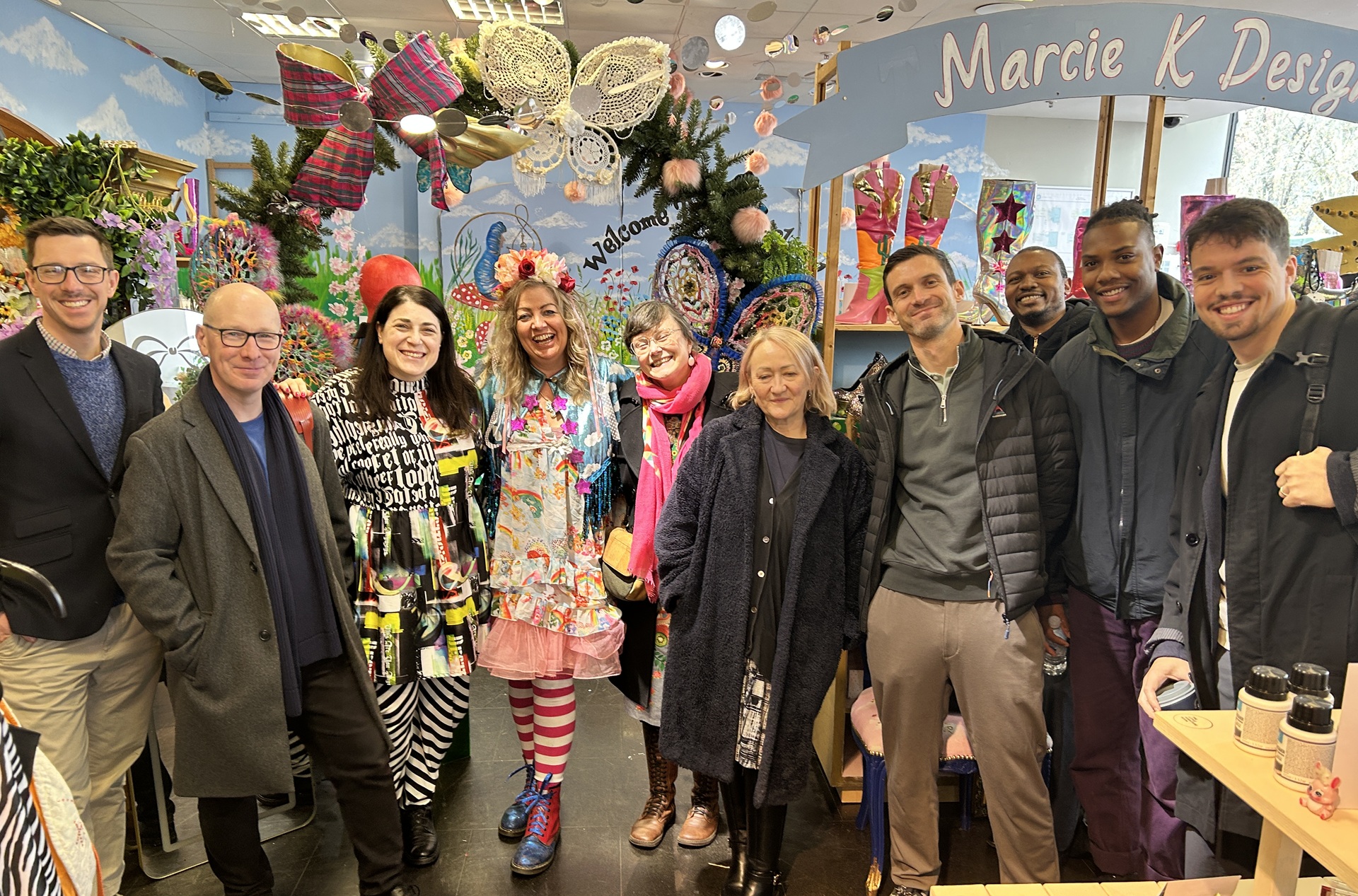
Before the meeting, the group visited Sparks, a department store with a difference in the former Marks & Spencer building in Broadmead. Co-created by Artspace Lifespace and the Global Goals Centre, it combines ethical retail, exhibitions, workshops, repair and affordable space for artists and makers – all on a meanwhile lease. This is a short-term, low-cost arrangement that lets an organisation use an empty building until the owner has longer-term plans for it, but it can usually be ended at short notice.
“There is no security with the meanwhile lease,” said Chiswell Jones. “Our lease ends in January. My whole business plan could be completely out the window.”
Matt Doran of the National Trust described how community groups often face two extremes: either leasing – placing them at risk of eviction – or being forced to absorb all the complexity, liability and risk of legal ownership whilst trying to start a business, deliver benefit and stay afloat. The Trust is developing a ‘safe harbour scheme’ in which a supportive owner creates the conditions for social enterprises and groups to occupy a historic building with minimal overheads, so they can focus on operating. Once they have shown they can successfully operate and generate a surplus to help maintain the building, the ownership would transfer. Post-transfer, long-term capital investment in the building would be more likely, as the occupiers have demonstrated a sustainable operation.
A fairer deal on rates
Clare Reddington of Watershed said the council had sought higher ground rent from the venue because “they think of us as the same as a potential Starbucks coming into the area” – even though the profits from its café bar funds charitable work. Chiswell Jones asked why a small baker working with the local community should pay the same rates as a Greggs or a betting shop, adding that social enterprises in Bristol have been unable to get discretionary rate relief since the council withdrew it in 2024, although councils elsewhere can still offer it. Hurley floated a classification that would allow differential business rates for organisations not run to maximise profit.
Money – and the skills to use it
Participants agreed that funding alone is not enough. Annabel Thomas MacGregor, CEO of nursery group Raised In CIC described a community group with plenty of goodwill but no experience of business planning, fundraising or running a building. Capacity-building money – for legal advice, feasibility work and business plans – was one of the most frequent calls of the session.
Alex Bunker, Policy Manager at Access – The Foundation for Social Investment, pointed to the Reach Fund, which has run for around a decade. It gives charities and social enterprises grants, typically £5,000 to £15,000, to pay for feasibility studies, lawyers, accountants and business plans as they prepare to raise investment. Every £1 of Reach funding, he said, leads to around £7 of investment.
Yasmin Ibison, Senior Policy Advisor at the Joseph Rowntree Foundation said asset ownership is around a third lower in “doubly disadvantaged” neighbourhoods, where groups struggle to win grants, and the grants they do win are smaller. She called for a move away from finite programmes towards permanent support that is universal in scope but weighted towards the places where need is greatest.
The government’s £61m Community Right to Buy Fund, announced in June, goes some way towards this: it is targeted at deprived areas and includes around £10m for capacity support. But it is less than half the size of the £150m Community Ownership Fund that closed in 2025, and the sector expects demand to outstrip it.
Vivienne Kennedy, Director of Operations at Bristol Business Improvement District put the challenge simply, calling for “a simple way of linking the people who’ve got good ideas with the people who know how to find and bid for money.”
What needs to change
Closing the session, Hurley asked each participant for their three asks of government. The most common was a holding vehicle (like National Trust’s ‘safe harbour’ idea) to give communities a longer, de-risked route to ownership. Many called for a free, searchable register of vacant buildings and land, showing who owns them and what condition they are in. Others wanted social enterprises’ social value properly recognised in rates, VAT and planning; a dedicated community ownership fund with capacity support built in; and a “first resort” policy, proposed by Chiswell Jones, so that public bodies must justify taking an asset out of community use. Drew Ritchie of Better Society Capital urged government not to “let developers off the hook”, making community ownership a condition of new development from the start.
Evidence from the session will feed into an APPG report in 2027, with recommendations for government.